What is Antinatalism?
Antinatalism is a philosophical position that views procreation as unethical and morally unjustifiable. Antinatalists argue that humans should abstain from making children. Wikipedia
There are various reasons why human reproduction is problematic. Some of the most common arguments for antinatalism include that life entails inevitable suffering, death is inevitable, and humans are born without their consent (that is to say, they cannot choose whether or not they come into existence). Additionally, although some people may turn out to be happy, this is not guaranteed, so to procreate is to gamble with another person's suffering. There is also an axiological asymmetry between good and bad things in life, such that coming into existence is always a harm, which is known as Benatar's asymmetry argument.
Why Coming Into Existence Is Always a Harm
David Benatar argues that there is a crucial asymmetry between the good and the bad things, such as pleasure and pain:
- the presence of pain is bad;
- the presence of pleasure is good;
however
- the absence of pain is good, even if that good is not enjoyed by anyone;
- the absence of pleasure is not bad unless there is somebody for whom this absence is a deprivation.
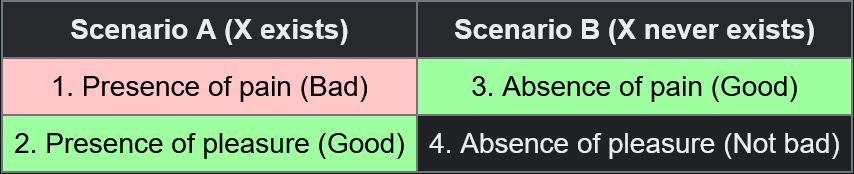
The argument follows that coming into existence generates both good and bad experiences, pain and pleasure, whereas not coming into existence entails neither pain nor pleasure. The absence of pain is good, the absence of pleasure is not bad. Therefore, the ethical choice is weighed in favor of non-procreation.
Supporting Asymmetries
- The asymmetry of procreational duties : we have a moral obligation not to create unhappy people and we have no moral obligation to create happy people. The reason why we think there is a moral obligation not to create unhappy people is that the presence of this suffering would be bad (for the sufferers) and the absence of the suffering is good (even though there is nobody to enjoy the absence of suffering). By contrast, the reason we think there is no moral obligation to create happy people is that although their pleasure would be good for them, the absence of pleasure when they do not come into existence will not be bad, because there will be no one who will be deprived of this good.
- The prospective beneficence asymmetry : it is strange to mention the interests of a potential child as a reason why we decide to create them, and it is not strange to mention the interests of a potential child as a reason why we decide not to create them. That the child may be happy is not a morally important reason to create them. By contrast, that the child may be unhappy is an important moral reason not to create them. If it were the case that the absence of pleasure is bad even if someone does not exist to experience its absence, then we would have a significant moral reason to create a child and to create as many children as possible. And if it were not the case that the absence of pain is good even if someone does not exist to experience this good, then we would not have a significant moral reason not to create a child.
- The retrospective beneficence asymmetry : someday we can regret for the sake of a person whose existence was conditional on our decision, that we created them – a person can be unhappy and the presence of their pain would be a bad thing. But we will never feel regret for the sake of a person whose existence was conditional on our decision, that we did not create them – a person will not be deprived of happiness, because they will never exist, and the absence of happiness will not be bad, because there will be no one who will be deprived of this good.
- The asymmetry of distant suffering and absent happy people : we feel sadness by the fact that somewhere people come into existence and suffer, and we feel no sadness by the fact that somewhere people did not come into existence in a place where there are happy people. When we know that somewhere people came into existence and suffer, we feel compassion. The fact that on some deserted island or planet people did not come into existence and suffer is good. This is because the absence of pain is good even when there is not someone who is experiencing this good. On the other hand, we do not feel sadness by the fact that on some deserted island or planet people did not come into existence and are not happy. This is because the absence of pleasure is bad only when someone exists to be deprived of this good.
Disagree? Here's A Large List of Counterarguments
Archive
might take a while to load..
Complaints?